
A Case Study in Hazardous Materials Transport, Infrastructure Risk, and Catastrophic BLEVE Events
Major industrial disasters often reveal the hidden vulnerabilities that exist at the intersection of transportation, infrastructure, and human decision-making.
One such event occurred on 24 December 2022 in Boksburg, South Africa, when a road tanker carrying liquefied petroleum gas (LPG) became lodged beneath a railway bridge and later exploded in a devastating Boiling Liquid Expanding Vapor Explosion (BLEVE).
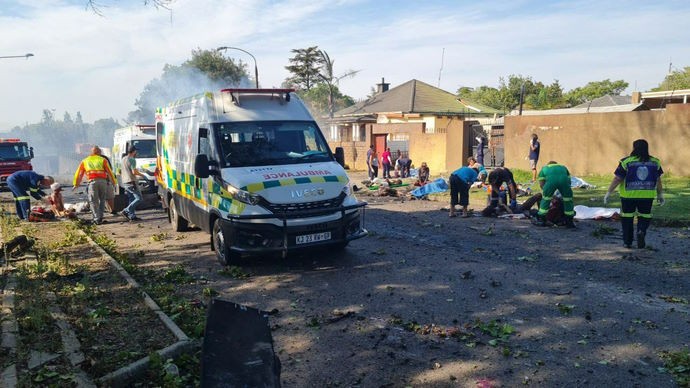
The explosion ultimately claimed 41 lives, injured dozens more, and damaged surrounding buildings, including a nearby hospital.
Beyond its immediate human tragedy, the event presents critical lessons for the global transportation of hazardous materials. These lessons are relevant not only in South Africa but also in the United States and other jurisdictions where thousands of hazardous-materials tanker trucks travel daily through populated areas.
This article examines the incident as a technical case study, focusing on Hazardous materials transportation risks, Infrastructure clearance hazards, Emergency response dynamics, BLEVE physics, and Forensic investigation considerations.
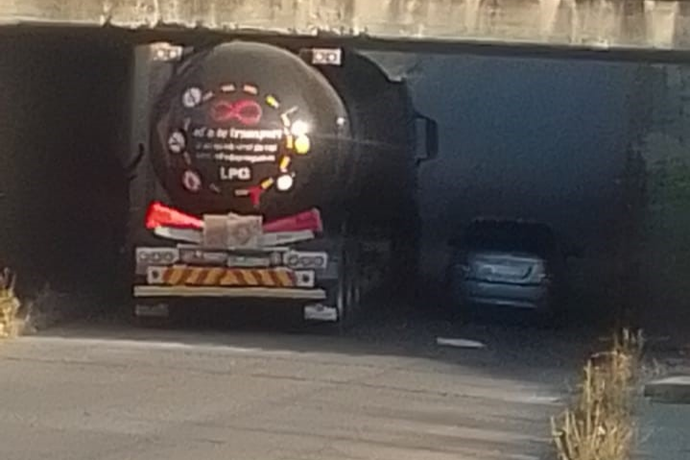
On the morning of 24 December 2022, a tanker truck carrying approximately 60,000 litres of liquefied petroleum gas (LPG) was travelling through the city of Boksburg in the Gauteng Province of South Africa.
The tanker had been transporting LPG from the Port of Richards Bay toward Botswana, a route frequently used for fuel distribution across southern Africa.
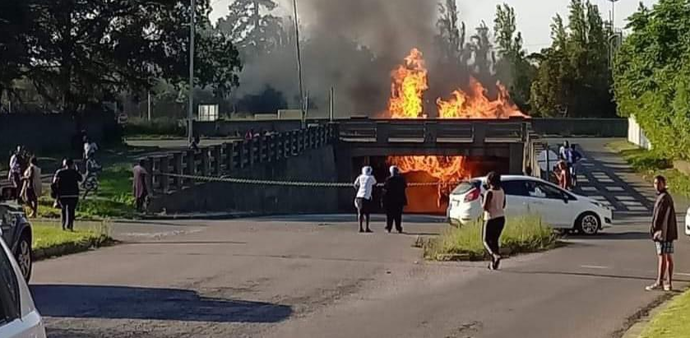
At approximately 06:15 AM, the tanker attempted to pass beneath a low railway bridge near Hospital Road. Due to the roadway geometry and incline approaching the bridge, the rear section of the tanker made contact with the bridge structure and became wedged beneath it.
The impact likely damaged the tanker vessel or associated piping, resulting in a release of LPG.
LPG is stored as a pressurized liquid that rapidly vaporizes when released. Once the gas began escaping, the situation quickly escalated.
Gas Release and Escalation
Liquefied petroleum gas presents a unique hazard profile.
Unlike many industrial gases, LPG vapor is heavier than air, meaning it can accumulate and spread along the ground in confined or low-lying areas.
In this case, the leaking gas likely accumulated beneath the bridge structure and nearby roadway.
Several critical events occurred in sequence:
- The tanker became stuck beneath the bridge.
- LPG began escaping from the tanker.
- Gas accumulated beneath the bridge and the surrounding roadway.
- An ignition source caused a flash fire or vapor cloud ignition.
- The tanker became engulfed in flames.
Technical analyses later suggested that the tanker may have been exposed to direct flame heating for approximately 45 minutes, a critical factor in BLEVE development.
The final explosion occurred roughly one hour after the initial incident, producing a massive fireball and shockwave.
This type of explosion is known as a BLEVE (Boiling Liquid Expanding Vapor Explosion).
A BLEVE occurs when a pressurized vessel containing a liquefied gas, when the gas is heated by external fire, causing internal pressure to increase until the tank catastrophically fails.
When the tank ruptures, the superheated liquid instantly vaporizes, producing an enormous blast and fireball.
In Boksburg, the explosion destroyed nearby vehicles, severely damaged surrounding buildings, and affected structures up to 400 meters away.
The blast was reportedly felt several kilometers away.
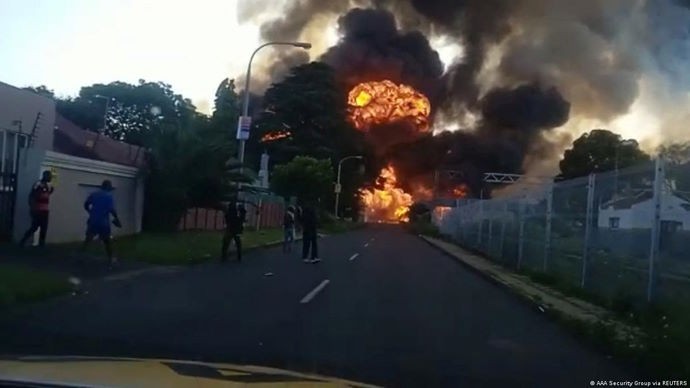
BLEVEs are particularly dangerous because they can happen unexpectedly and release a large amount of energy in a short amount of time. The pressure wave and heat generated by the explosion can cause severe burns and injuries, and can be fatal to any people who are near the explosion.
Also, if you are in the vicinity of a facility that stores or uses pressurized containers of flammable liquids, it is important to be familiar with emergency evacuation procedures and to be prepared to follow them in the event of an incident. Additionally, if you are in a vehicle, it is best to stay inside the vehicle with windows closed and AC/Heater off until the incident is resolved, or the emergency services have cleared the area.
As an example, Butane and Methane are both hydrocarbons that are made up of hydrogen and carbon. Here are some of the technical properties of butane and methane:
Butane:
- Molecular formula: C4H10
- Boiling point: -0.5 °C (31.1 °F)
- Melting point: -138.4 °C (-216.1 °F)
- Density (at 20 °C, 1 atm): 2.48 kg/m³
- Specific gravity (at 20 °C): 0.582
- Flashpoint: -11 °C (12.2 °F)
- Autoignition temperature: 446 °C (835 °F)
Methane:
- Molecular formula: CH4
- Boiling point: -162 °C (-259 °F)
- Melting point: -182.5 °C (-298.5 °F)
- Density (at 0 °C and 1 atm): 0.717 kg/m³
- Specific gravity (at 15.6 °C): 0.554
- Flashpoint: -161 °C ( – 258 °F)
- Autoignition temperature: 537 °C (999 °F)
It is important to note that these properties can vary depending on the specific conditions under which the substances are being measured. Additionally, it is worth mentioning that while both are hydrocarbons, they have different behaviour. For example, Butane is a more volatile substance and is commonly used as a fuel source for lighters, camping stoves, and portable gas heaters. Methane is also used as a fuel source, but it is also a key component of natural gas, which is used as a source of heat and electricity.
The blast radius of a BLEVE is affected by several factors, including the size and pressure of the pressurized container, the properties of the liquid or gas inside the container, and the surrounding environment. One of the most important factors in determining the blast radius of a BLEVE is the amount of product involved in the incident.
To calculate the blast radius of a BLEVE, various models and equations are used, based on the nature of the explosion, the properties of the substance, and the geometry of the container. These models can consider factors such as the amount of liquid or gas in the container, the pressure inside the container, the size and shape of the container, and the properties of the liquid or gas.
For example, if we take a hypothetical scenario where the pressurized container is a cylindrical vessel with a volume of 60000 litres and contains propane at 80% of its liquid capacity, the blast radius can be calculated as follows:
- Step 1: Determine the energy of the explosion: The energy of the explosion for propane is about 2.5 KJ/g. So, for 60000 litres of propane, the total energy of the explosion would be 2.5 x (60000 x 0.8) = 900,000 KJ.
- Step 2: Determine the overpressure: The overpressure created by the explosion is the ratio of the maximum pressure to the atmospheric pressure. This can be calculated by using the relation P = E/V, where E is the energy of the explosion and V is the volume of the cylindrical container. The overpressure can be estimated to be 15-20 kPa
- Step 3: Determine the blast radius: This can be determined using the following relation R = (P/r)^1/3, where R is the blast radius, P is the overpressure, and r is the density of air (1.225 kg/m³). The blast radius can be estimated to be around 31-35 meters
It is important to note that these calculations are approximate, and the actual blast radius may vary depending on the specific conditions of the incident. The above calculation also does not take in the structural and topographical factors of the incident site, which can affect the blast radius.
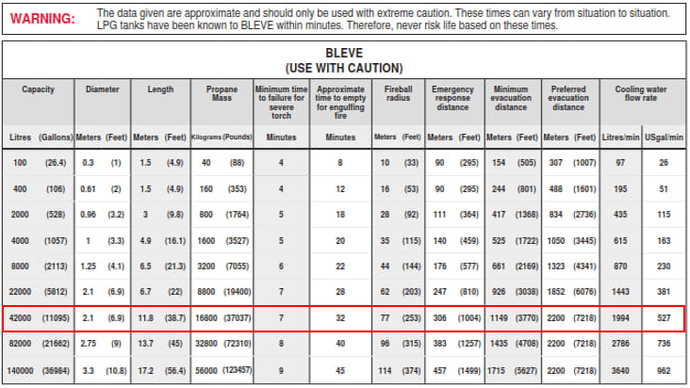
To avoid fatal or serious injury in the event of a BLEVE, it is important to stay as far away as possible from the pressurized container. In general, the Emergency Response Guidebook 2020 recommends an evacuation radius of at least 1,5 km and a preferred evacuation distance of perhaps as much as 2,2 km away from a BLEVE incident to minimize the risk of injury or death.
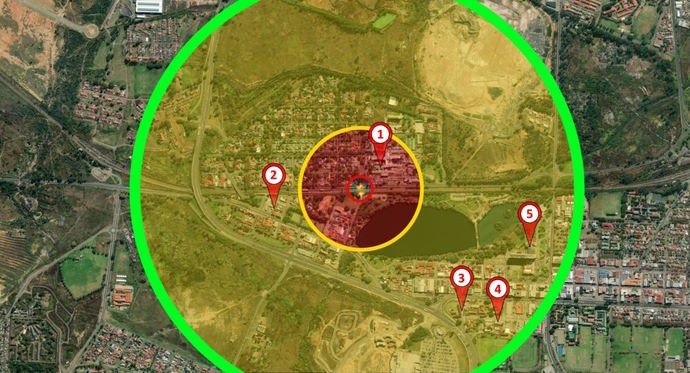
From this illustration, and according to the Emergency Response Guidebook, the following can be seen:
- The Blast (Fireball) radius, circled in red, is approximately 77m.
- The EMS distance – the closest that Emergency Services should be from the scene is approximately 306m.
- The minimum evacuation distance, circled in green, is the area that should be evacuated, for safety.
- The ideal area that should be evacuated is about twice that – the area outside the green circle.
- The Thambo Memorial Hospital (Pin 1) is within the EMNS distance, and very close to the blast area.
- The Boksburg Police Station (Pin 2) is only 560m away – well within the minimum evacuation zone.
- The Boksburg Fire Department (Pin 3) is only 790m away – well within the minimum evacuation zone.
- The Ekurhuleni Metro Police Office (Pin 4) is only 970m away – also well within the minimum evacuation zone.
- Even the Ekurhuleni Municipal Buildings (Pin 5) is only 930m away – well within the minimum evacuation zone.
People exposed to a BLEVE explosion at close range -= anyone within the inner red circle – are likely to suffer from a range of injuries depending on their proximity to the explosion, their protective measures, and the nature of the explosion. The following are some of the likely mechanisms of injury and causes of death for people exposed to a BLEVE explosion at close range:
- Burns: The intense heat and flame generated by a BLEVE explosion can cause severe burns to the skin and internal organs. These burns can range from first-degree burns to third-degree burns and can be fatal if they cover a large percentage of the body or involve the face, airway, or vital organs.
- Blast trauma: The pressure wave generated by a BLEVE explosion can cause a range of traumatic injuries, such as blunt trauma, lacerations, fractures, and dislocations. These injuries can occur as a result of being thrown by the blast wave, being struck by debris, or being crushed by collapsing structures.
- Asphyxiation: A BLEVE explosion can release toxic gases, such as carbon monoxide and hydrogen cyanide, which can cause asphyxiation and suffocation. These gases can displace the oxygen in the air, making it difficult for people to breathe, and can cause brain damage or death if exposure is prolonged.
- Projectile injury: The blast can create projectiles like broken pieces of the container, equipment, or debris that can fly at high speed and cause serious injuries such as lacerations, fractures, or penetrative injuries.
- Cardiac Arrest: The intense psychological and physical trauma caused by a BLEVE explosion can trigger cardiac arrest in certain individuals.
- Dismemberment: The shockwave of a BLEVE incident is so severe that anyone within the immediate blast radius (less than 77m) might be dismembered. In the Boksburg case, this was graphically illustrated when a hand was found in a nearby tree, days later.
It’s crucial to note that these are just some of the possible mechanisms of injury and causes of death, and there can be a wide range of injuries depending on the specific circumstances of the BLEVE incident. The best way to avoid these injuries is to stay away from the pressurized containers and not approach or film the scene of an accident involving these containers.
Here are some general guidelines for treating people with serious injuries caused by a BLEVE explosion:
- Call for emergency medical assistance immediately. This is the most important step that should be taken as soon as possible.
- Check for responsiveness and pulse. If the person is not responsive, begin CPR if trained.
- Assess the injuries and provide first aid accordingly. The injuries caused by a BLEVE explosion can range from burns to traumatic injuries, so it is important to evaluate the person’s condition and provide appropriate care.
- For traumatic injuries, such as fractures or dislocations, immobilize the affected area to prevent further injury.
- If there is a suspected inhalation injury, quickly move the person to a location with fresh air and monitor their breathing
- Be aware of possible toxic gas or chemical exposure and take appropriate safety measures to protect yourself and the patient.
- If you can smell any chemicals, you are too close to the source, and you and your patients need to be evacuated as a matter of utmost urgency, even before any fire starts.
It’s crucial to note that these are general guidelines, and the treatment will be based on the specific circumstances and conditions of the patient. Also, it’s important to remember that first aiders should not exceed their level of training and should always follow the protocols provided by local emergency services.
It’s vital to remember that BLEVE explosions are highly dangerous incidents and can cause severe injuries and death. The best way to avoid these injuries is to stay away from the pressurized containers and not approach or film the scene of an accident involving these containers.
When you see a truck accident involving propane or butane gas, it is essential to call 10177, 10111, 084 124, or 112 immediately to alert emergency responders to the situation. When making the call, the dispatchers will need certain information to ensure that the appropriate response is deployed to the scene of the accident. Here is a list of information that will be required by dispatchers when calling 911 in such a situation:
- The location of the accident, including the street address or nearest intersection, as well as any landmarks or landmarks nearby.
- The number of vehicles involved in the accident
- A description of the accident, including the severity of the accident, the extent of damage to the vehicles, and any leakage of the propane or butane gas
- Any injuries or fatalities that have occurred as a result of the accident.
- Description of the truck and its cargo, including the type of gas and the size of the container/tanker.
- Any fire or explosion that occurred, and the status of the fire.
- Whether or not people have been evacuated from the area, and if not, the number of people in the immediate vicinity.
- Your name and phone number for follow-up questions.
It’s important to remain calm and speak clearly when providing this information to the dispatcher and follow their instructions. Providing accurate and timely information can help emergency responders to respond effectively to the accident and minimize the risk of injury or loss of life.
It is also important not to leave the area of the accident until emergency services arrive and ask you to do so. Whenever any chemicals are involved, stay as far back as possible and don’t approach the site, allowing the emergency responders to do their job.
